Study Notes on "Practical Training for Commercial Product Managers"
I’ve always believed that looking at things from different perspectives leads to a more comprehensive understanding and interesting conclusions. Therefore, being used to viewing commercial advertising from the RD perspective, I long wanted to see things from the product/operations/sales perspective. Recently I found a course on commercial product managers, “Practical Training for Commercial Product Managers”. Although it’s from a few years ago, some content is still relevant today and gave me a better understanding of commercial products.
The course mainly covers four major parts (actually five chapters, but I skipped the advanced advertising part as I’m familiar with it): definition and evolution of commercial products, responsibilities and methodology of commercial product managers, validating commercial product requirements, and commercial products from 0 to 1. This article follows these four parts, with content organized and only excerpting what I care about. I recommend watching the original video.
Definition and Entry Points of Commercial Products
This section introduces the definition, timing, mode selection, and entry points of commercial products (some content is from the fifth lecture but I think it fits better here).
Definition
Commercial products need to satisfy the following three elements:
- Payment target
- Service/product
- Pricing & distribution mechanism
Connecting these three elements: identify the payment target, provide specific services/products to meet the payment target’s needs, while establishing a pricing & distribution mechanism to charge the payment target accordingly.
Common commercial products have two charging modes: forward charging and backward charging.
Forward charging targets users, thinking about the optimal experience to provide users; common modes include various memberships, VIPs; the charging rules weren’t detailed in the video, but the logic can be found in Paid Membership System Analysis and VIP Membership Package Pricing Strategy.
Backward charging targets clients, combining user behavior to think about maximizing client effectiveness; the typical form is advertising; charging rules follow typical auction + GSP/VGG; the video covered some content about advertising evolution including ad formats, participants, charging modes, etc., but it’s basic so I won’t expand.
Timing and Entry Points
The tutorial also provided references for commercialization timing, simply put: start from when we can retain users. Quantified metrics include:
- User growth rate > User churn rate
- User retention rate > 40%
- LTV > CPA (minimum), LTV > 3CPA (best)
Commercialization mode selection is the forward and backward charging mentioned above. Points to note for both:
- Forward charging: Need to be cautious since users are used to free models, can try “basic features free + premium features paid” mode
- Backward charging: Advertising is common but need to consider user experience, make ads more native
The book used Meituan as an example, describing Meituan’s three monetization steps: CPL -> CPT -> performance advertising; the latter two are easy to understand, CPL means the platform collects commission after user purchase succeeds; but there’s a bypass problem where merchants might let users bypass the platform to order directly.
So how to find entry points for commercialization? The course mainly focuses on these 2 points:
- Customer/user demand analysis
- Platform resource inventory
The demand analysis in step 1 can be mined from these three aspects (here customer can be considered as commercial product user, while user is the user product user):
- What’s the purpose when customer opens app/website
- What’s the behavior path for customer to achieve the purpose
- Mine customer’s intrinsic needs (is there room for optimization in current path?)
The course used video membership as an example to introduce demand mining for this mode. Users watch movies, their traditional behavior path: open search engine -> search and download resources -> use computer player to open; now common video apps can better satisfy these needs. The path comparison:
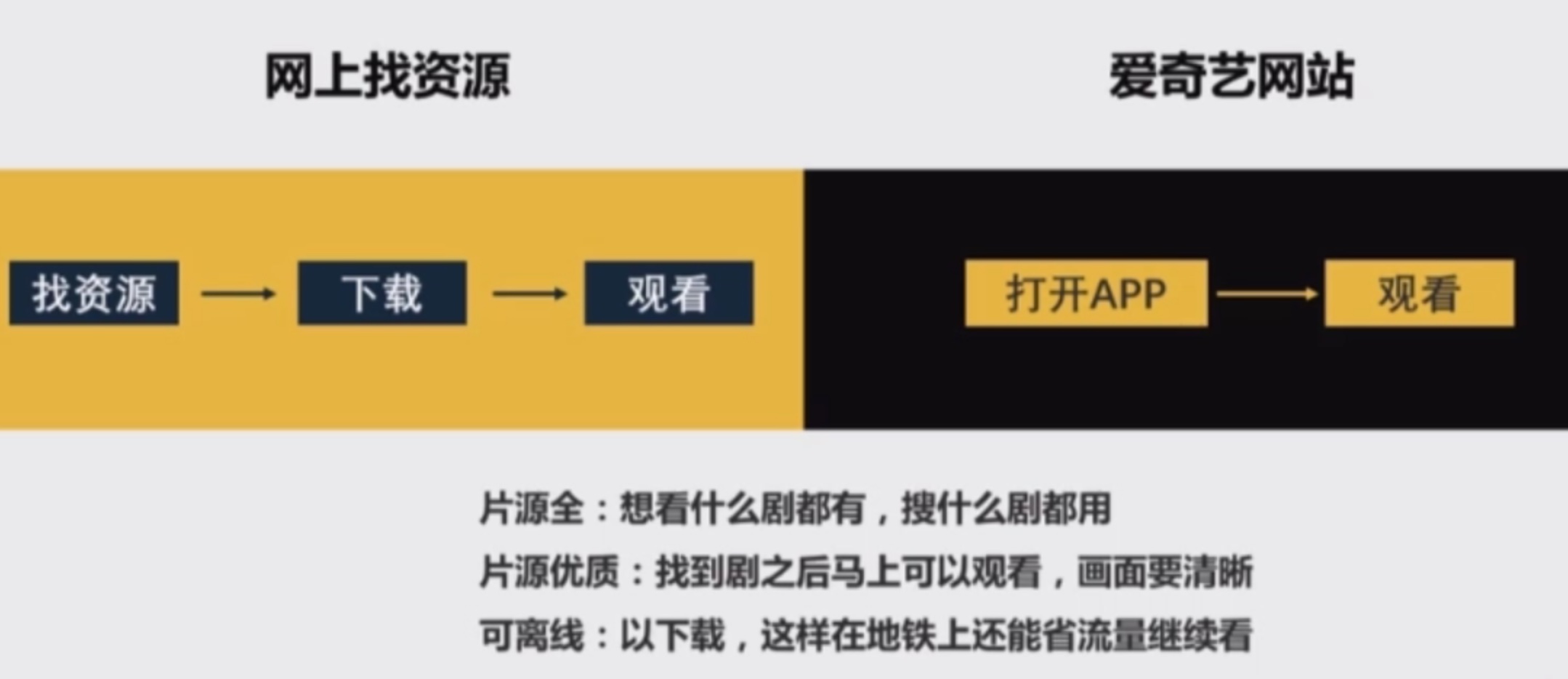
The platform resource inventory part didn’t have explicit methodology in the book. This part requires different background knowledge in different domains, but the basic method is “collect + classify”. “Collect” depends on personal sensitivity to information and whether information sources are sufficient. “Classify” has detailed methodologies to reference. I previously wrote Reading Notes on “Cognitive Dividend” (2) - Brain Upgrade, where the structured thinking part can be referenced. It mentions two specific methods: pyramid structure and plane cutting.
Commercial Product Manager
Role Positioning
Commercial product managers often have two roles:
- Product manager
- Seller
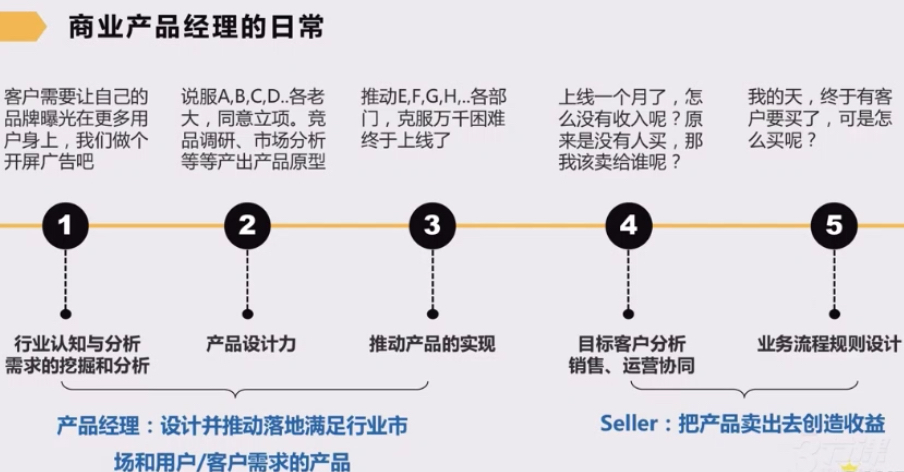
The first role’s responsibility is designing and driving implementation of products that satisfy industry market and user/customer needs, basically the same as user product manager responsibilities. More detailed division: (1) industry cognition and analysis, demand mining and analysis (2) product design capability (3) driving product implementation.
The second role’s responsibility is selling the product to create revenue. This part is more related to the sales stage. More detailed division: (1) target customer analysis, sales and operations coordination (2) business process rule design.
Taking advertising as an example, commercial product manager responsibilities:
The specific product promotion chain:
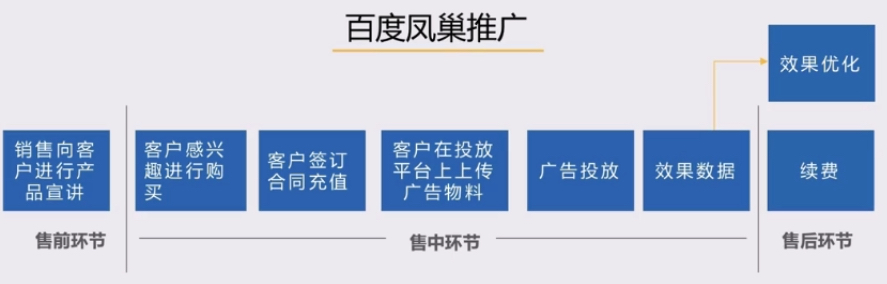
The course emphasized the pre-sales stage, dividing it into 3 steps with an overview of sales responsibilities in each:
- Sales lead collection: field sales, marketing websites (self-registration system)
- Selling: sales leads’ public/private pools, protection period (CRM system), more details in Overview of CRM System Development 2 - How to Develop Customers?
- Presentation: demos (providing related demos, data, etc.)
Methodology
The tutorial gave four points on “cultivation methods for commercial product managers”:
- Clarify product positioning
- Know how to tell stories
- User thinking
- Make good use of monitoring reports
1. Clarify Product Positioning
Product positioning is simply “the first reaction when customers think of the product”. Some examples:

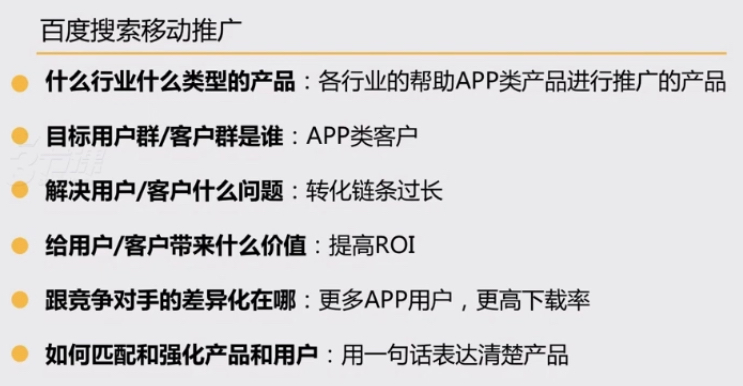
Further, product positioning can be clarified from these 6 aspects:
- What industry/type it belongs to
- Who are target users/customers
- What problems it solves for users/customers
- What value it brings to users/customers
- Differences from competitors
- How to match and strengthen product and users/customers
Being able to answer these 6 questions well means having a clear positioning for the product. Taking Baidu search mobile promotion as an example, the answers:
2. Know How to Tell Stories
Storytelling skill isn’t limited to product managers. The method mentioned in the course: (1) think from customer perspective (2) vividly describe what benefits customers get after using.
An example:
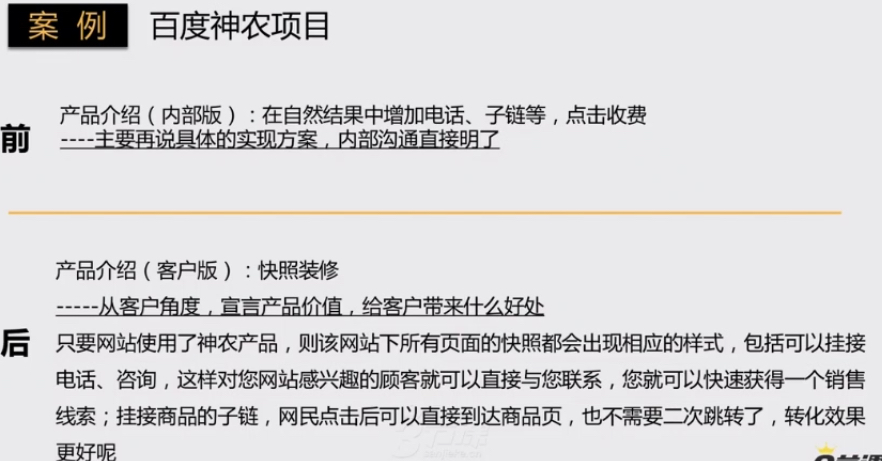
Detailed storytelling methodology wasn’t covered in the course. This can be referenced from this Zhihu answer: How to improve storytelling ability? - Feichai Xiao’s answer. Simply put: be specific, evoke audience empathy.
3. User Thinking
Commercial products serve the “sugar daddies” (paying clients) but also need to consider user experience, i.e., evaluate product quality from user perspective.
Backward charging monetization needs to pay special attention to this. Taking advertising as example, when showing ads need to note: (1) Don’t annoy users: in what scenarios users would be moved (2) Enhance interaction: user behavior paths on media platform (3) Improve effectiveness: user decision paths for conversion in different client industries
An example:
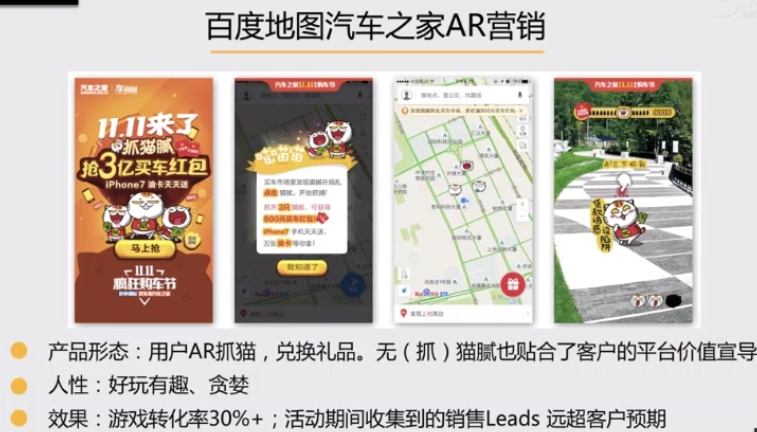
What methods to mine user thinking? The course briefly covered 3 angles: (1) Maslow’s hierarchy of needs (physiological needs -> spiritual needs), simply put: “well-fed people think about lust” (2) Human weaknesses (3) Big data analysis (actually various recommendation/ad models)
4. Make Good Use of Monitoring Reports
Using monitoring reports serves 2 main purposes: (1) understand revenue performance completion (2) understand if business model is healthy
- Understand revenue performance completion: need to monitor revenue progress, i.e., whether current revenue completion keeps up with time progress; further breakdown by industry, customer type, ad type, etc.
- Understand if business model is healthy: need to monitor customer metrics
- Churn rate: how many customers won’t purchase again
- Renewal rate: customer repurchase situation
- New accounts, retained, churned comparison: product’s new customer acquisition situation
- Customer count = new + retained - churned, new > churned ensures positive customer growth
Building monitoring reports needs:
- Metrics serve business: need to clarify specific business and who uses it. Decide what to focus on based on users. Below shows different metrics and dimensions for product and sales in advertising:
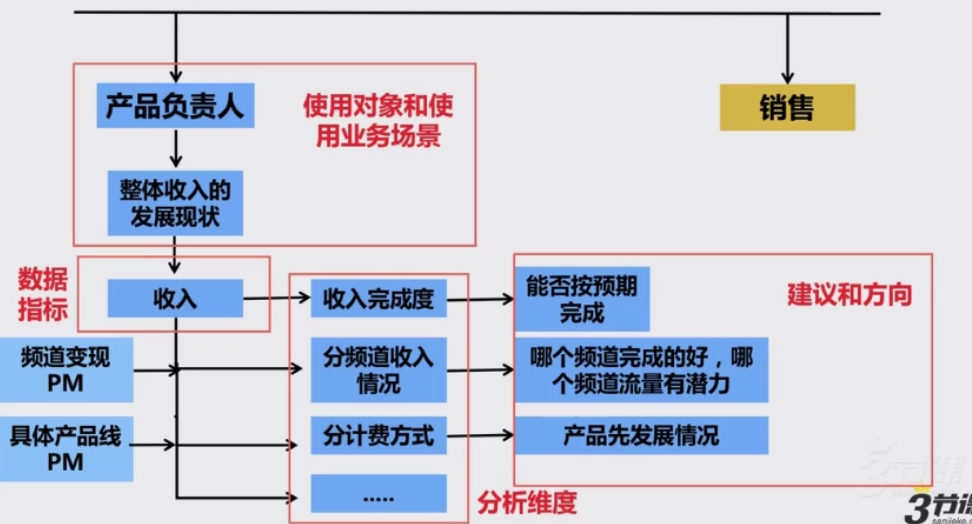
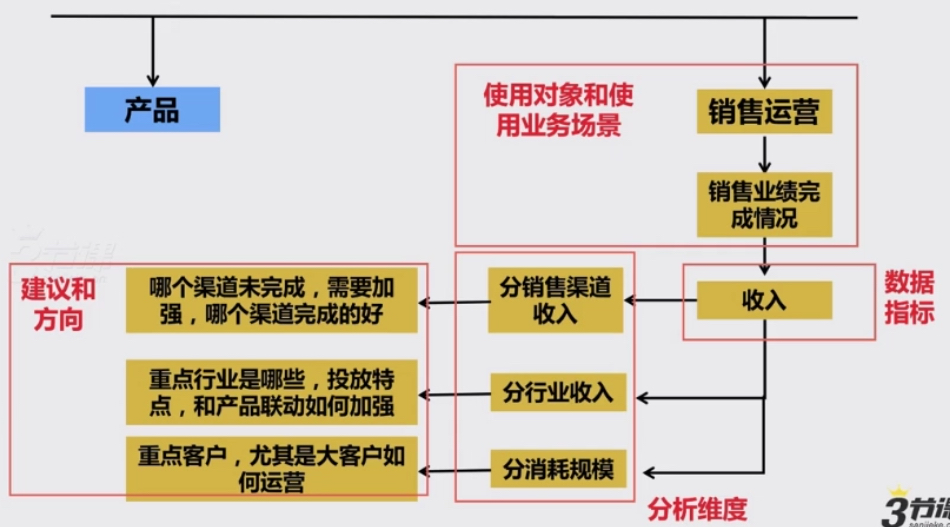
- Design overall framework: make the points from step 1 more concrete. Five aspects worth attention:
- Business scenario division: which business scenarios the monitoring platform needs to support
- Data metrics: what data metric system to use
- Analysis dimensions: from which dimensions to view these metrics (e.g., time, sales channel)
- Hierarchical relationships: do analysis dimensions have hierarchy, need drill-down (e.g., industry classification, further first-tier industry, second-tier industry)
- Presentation format: what charts for more intuitive analysis
Clarify data sources: need to ensure data source accuracy, timeliness, uniformity (data interpretable in larger scope)
Function module design: four modules listed:
- Permission management: ensure data confidentiality
- Key metric monitoring: data directly reflecting whether business goals are completed
- Real-time revenue data: besides periodic review of key data, need real-time monitoring to warn of business model problems
- Hierarchical structure: analyze from different dimensions, generally platform dimension (traffic, revenue on different platform traffic) and industry dimension (customers, revenue on different customer types) are essential
- Design principles: general principle is efficiently conveying data information to users, subdivided into functional design and interface design
Functional design needs to highlight core metrics, highlight comparisons, use hierarchical structure (provide breakdown and drill-down) Interface design needs to be simple, avoid too many colors, choose correct visualization forms
Validating Commercial Product Requirements
Demand Analysis
The course gave the classic Ford car versus horse case, mainly showing customers have explicit and implicit needs, and implicit needs reflect the customer’s essential problem.

How to mine customer’s implicit essential needs? The course gave three suggestions:
- Identify analysis target (target customer group), whose problems to solve
- Clarify goal, can solving immediate problems achieve ultimate goal?
- Empathize, think from customer perspective
Let me emphasize the empathy part: need to describe products or requirements in customer language, experience like a customer, understand the real need behind explicit needs; need to complete the transformation from platform thinking to customer thinking. Some common examples:
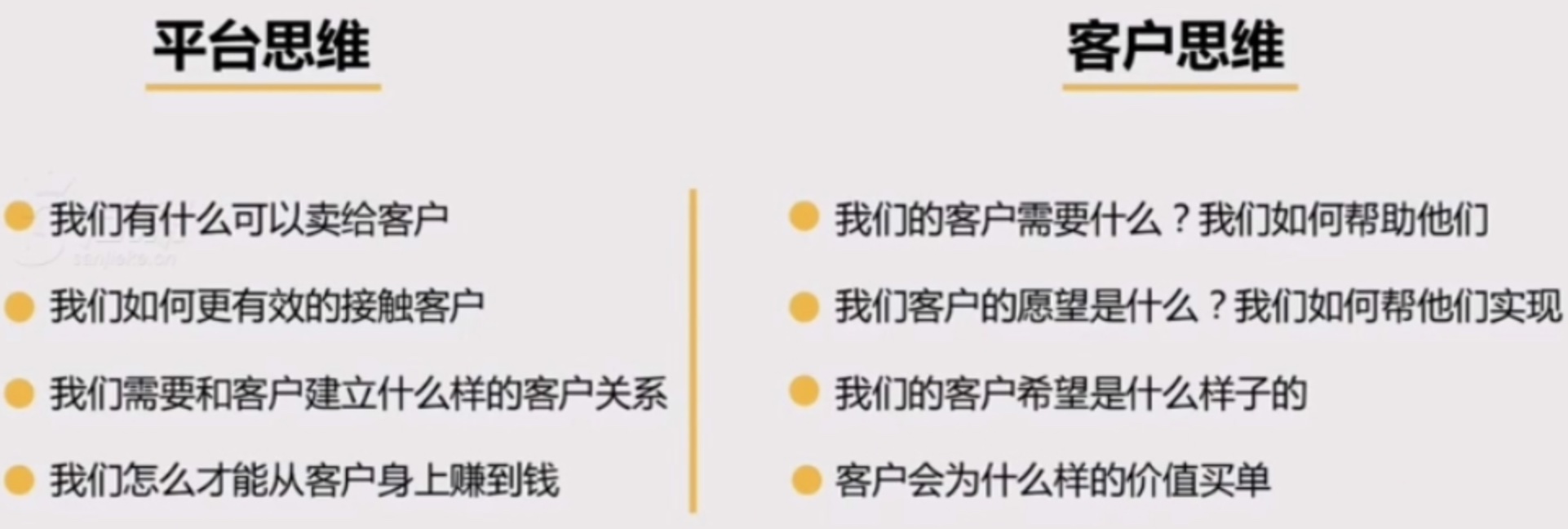
Common methods in practice for mining these needs include:
- Questionnaire
- Commonly for existing products, objective multiple choice
- Judge customer satisfaction/acceptance
- Solution priority ranking or N choose 1, generally 3% response rate
- Phone
- Commonly for deep demand mining
- No more than 3 questions
- Face-to-face interview
- Commonly when no answer/solution for preset questions, doing comprehensive demand collection
- Open-ended questions, guide customer to talk more but with direction
- Grasp key points from customer answers and follow up
Data Analysis
Data analysis has three key elements: find metrics, read metrics, metric decomposition.
- Find metrics
Metrics need simplicity, comparability, and consistency with company goals.
- Read metrics
Only metrics and values are meaningless, need reference values. Reference values can come from:
- Compare with self: year-over-year, month-over-month for anomalies, services that improved/declined
- Compare with industry benchmarks: growth, active user count, customer acquisition cost, etc.
- Metric decomposition
This part has three specific steps: confirm main metric -> confirm calculation formula -> multi-dimensional decomposition
- Confirm main metric: identify the most meaningful metric at current stage
- Confirm calculation formula: decompose goal into quantifiable formula, find related metrics
- Multi-dimensional decomposition: commercial products usually start from two dimensions: traffic (supply), customers (demand);
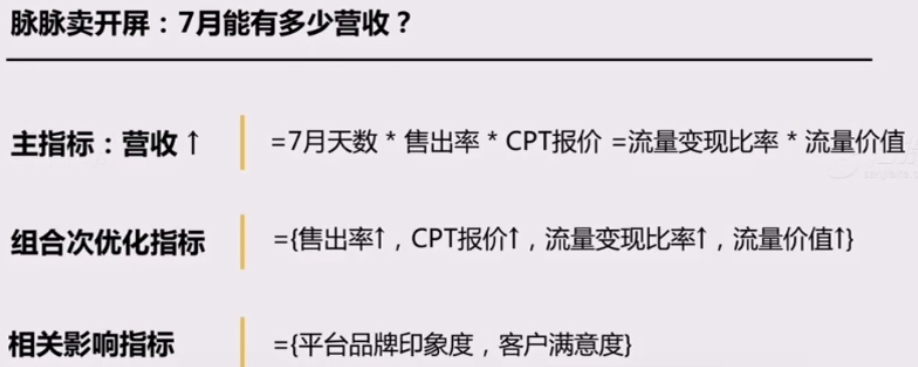
Also, commercial products worth attention can often be approached from 2 dimensions: from traffic perspective, revenue = impressions x CPM; from customer perspective, revenue = customer count x ARPU.
Competitive Product Research
Competitive product research also has 3 main elements: purpose, methods, results
- Purpose: select analysis target
- Methods: various comparative analyses
- Results: discussion and propose solutions
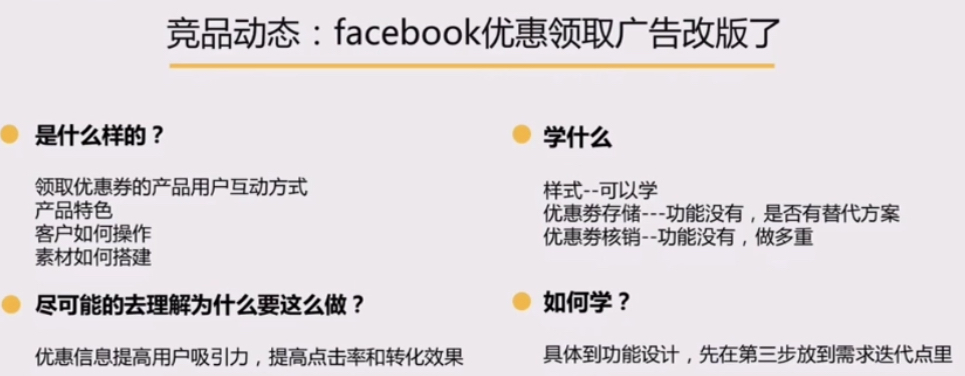
During research, frequently ask these four questions:
- What is the competitive product
- Why do they do this
- Should we follow
- How to follow
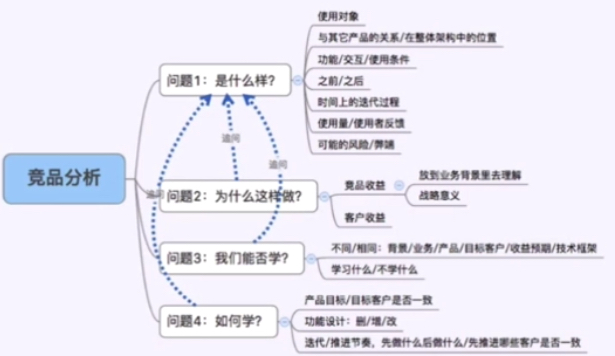
The course used Facebook as an example to explain this process:
Commercial Product from 0 to 1
Commercial products usually follow: demand analysis -> demand screening -> product design -> release validation -> launch operations.
Demand Analysis
This is the content covered in the third part “Validating Commercial Product Requirements” above, divided into demand analysis, data analysis, and competitive analysis.
Demand Screening
This part filters important demands from candidate demands obtained in the first part based on ROI. This content is similar to “valuing ideas” in Reading Notes on “Cognitive Dividend” (1) - Concept Reshaping, recommend reading together.
Demand screening usually evaluates from four aspects and provides reference comprehensive score:
- Business revenue evaluation
- Implementation cost
- Customer acceptance
- Legal risk
The comprehensive score calculation formula:

But the above formula is just a reference. In practice it’s more flexible, but these three basic principles must be followed:
1. Sort by comprehensive score 2. Risk has veto power 3. Don’t challenge customers
Product Design
In product design, the most common deliverable is requirement documents. Requirement documents are often divided into three types: BRD (Business Requirement Document), MRD (Market Requirement Document), and PRD (Product Requirement Document), corresponding to the process from research to execution. Detailed differences in the figure below.
The course focused on PRD writing specifications, summarized as 3+2+1 basic elements:

Additionally, document output needs to follow the “0123 principle”:
- 0: No explanation or help needed
- 1: Understand at a glance
- 2: Two second wait time
- 3: Within three steps operation
Product Development
This part wasn’t detailed in the course. Commercial product managers in this process should clarify development progress and ensure normal development progress.
Pre-release Validation
The validation here refers to common AB small traffic experiments, basically two modes: traffic circle and customer circle, i.e., traffic-side experiments and user-side experiments.
User-side experiments can also be divided into two types: 1. Randomly circle customers, no customer participation needed 2. Circle specified customers, requires strong customer participation
Launch Operations
After product launch, need to coordinate with operations to expand product coverage. Common methods:
- Product promotion
- Product training
- Operations incentives
Product promotion is disclosing the product to users and related operations personnel so they know such a product exists. Common methods:

Product training is teaching customers to use the product. Need to do this from customer perspective, i.e., think what value it brings to customers.
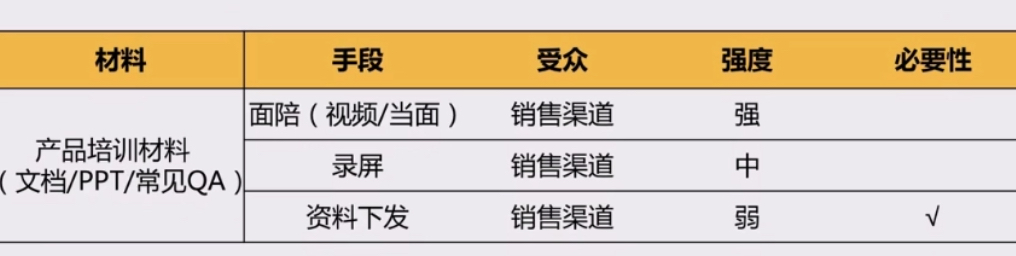
Operations incentives have two common methods:
- Performance allocation: strongly bind with performance
- Activity incentives: apply for bonuses as activity incentives
Summary
The course mainly covered four parts, with key points:
- Commercial product definition and entry
- Three elements of commercial product definition, forward and backward charging modes
- Start commercialization after being able to retain users, three quantitative conditions
- Enter commercialization from customer needs and platform resource inventory
- Commercial product manager
- Shoulder product manager and seller responsibilities
- Cultivation methodology: clarify product positioning, tell stories, user thinking, use monitoring reports
- Valid commercial product requirements
- Demand analysis: clarify whose problems to solve, need empathy (platform thinking vs customer thinking)
- Data analysis: find core metrics, reading metrics needs comparison values, formula decomposition, multi-angle analysis (supply and demand)
- Competitive research: 4 questions, what, why, whether, how
- Commercial product from 0 to 1
- Demand analysis (see above)
- Demand screening: focus on ROI, customer acceptance, legal risk; 3 basic principles
- Product design: 3 types of requirement documents, 0123 output principle
- Product development: control progress
- Product release validation: AB experiments, traffic-side and customer-side
- Post-launch operations: product promotion, product training, operations incentives
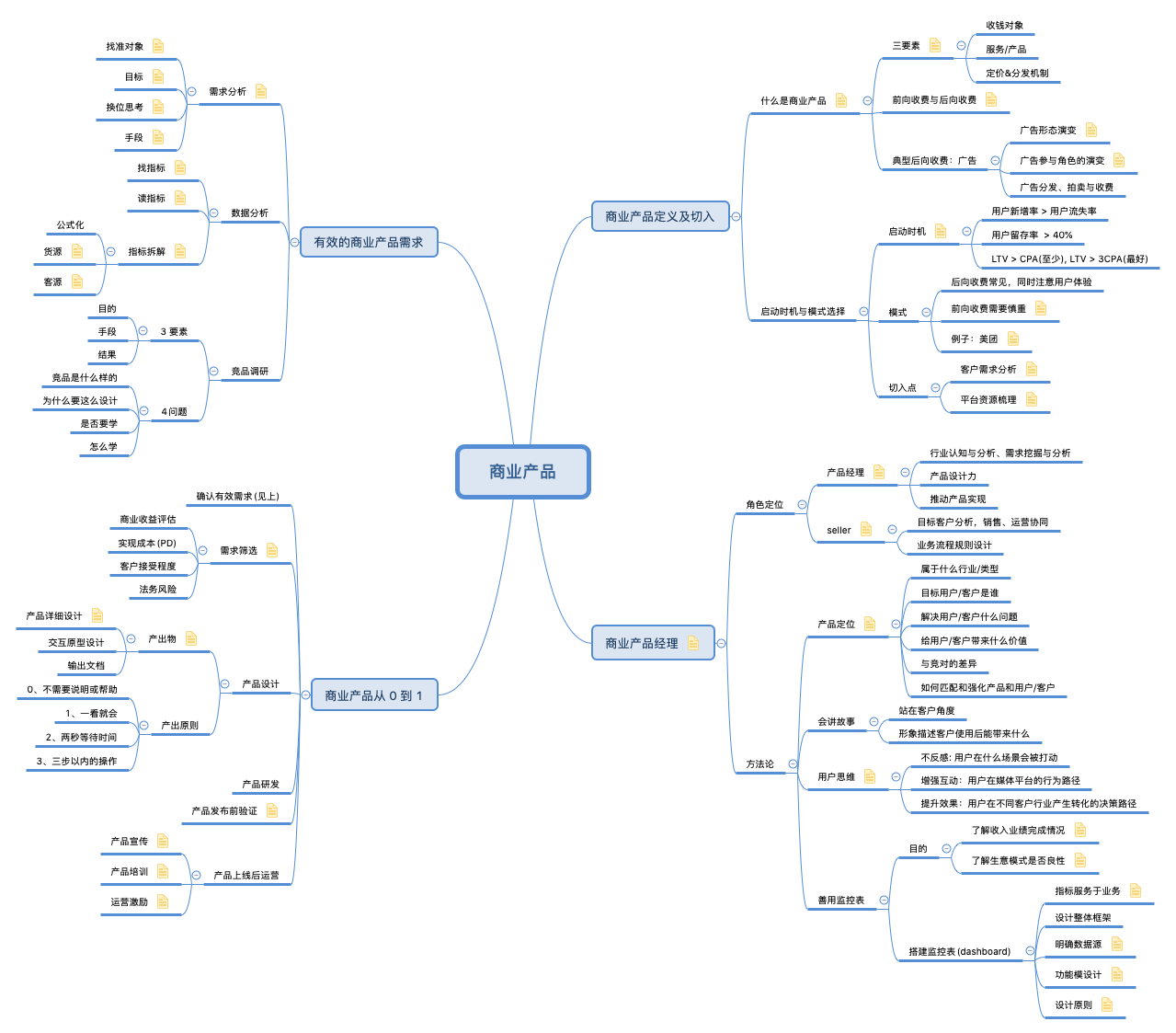
Overall mind map: