Creator Monetization and Content Heating
Recently I’ve been working on creator-related business. Compared to the traditional three parties in commercialization (platform, users, advertisers), creators are the fourth party that emerged with content platform rise. Their relationship with other parties can be found in my earlier article Yet Another Overview of an AD System.
This article expands on creator-related parts from the previous article, mainly covering opportunities and content heating. The former includes responsibilities of various links in the opportunity part and their relationships. The latter includes self-delivery and proxy delivery product forms, and their coordination with ad traffic in traffic mechanisms.
Opportunities
Platforms like Xingtu, Pugongying, Juxing, Huahuo are official platforms providing opportunities for creators (there are also collaborations not going through official platforms, hereafter called underwater).
From user perspective, these products connect clients (B) and creators (K), a supply-demand matching platform. B reaches collaboration with K through fixed-price or recruitment methods on the platform, pays for K to create and publish content, equivalent to B paying for K’s content and traffic.
From platform perspective, these products connect community and advertising, one end connecting community as an important tool for creator operations and growth, the other end connecting advertising as an important content supply for ad creatives. Therefore, these products often need to consider both K-side and B-side business objectives.
In implementation, these products generally involve three links: matching link, recommendation link, and ad link, as shown below. Each link’s responsibilities:
- Matching link: B finds corresponding K to create content (video, article, livestream, etc.)
- 推荐 link: K publishes content, recommendation link distributes K’s published content, obtaining natural traffic
- Ad link: B or K decides whether to additionally pay to heat corresponding content, or use this content for advertising
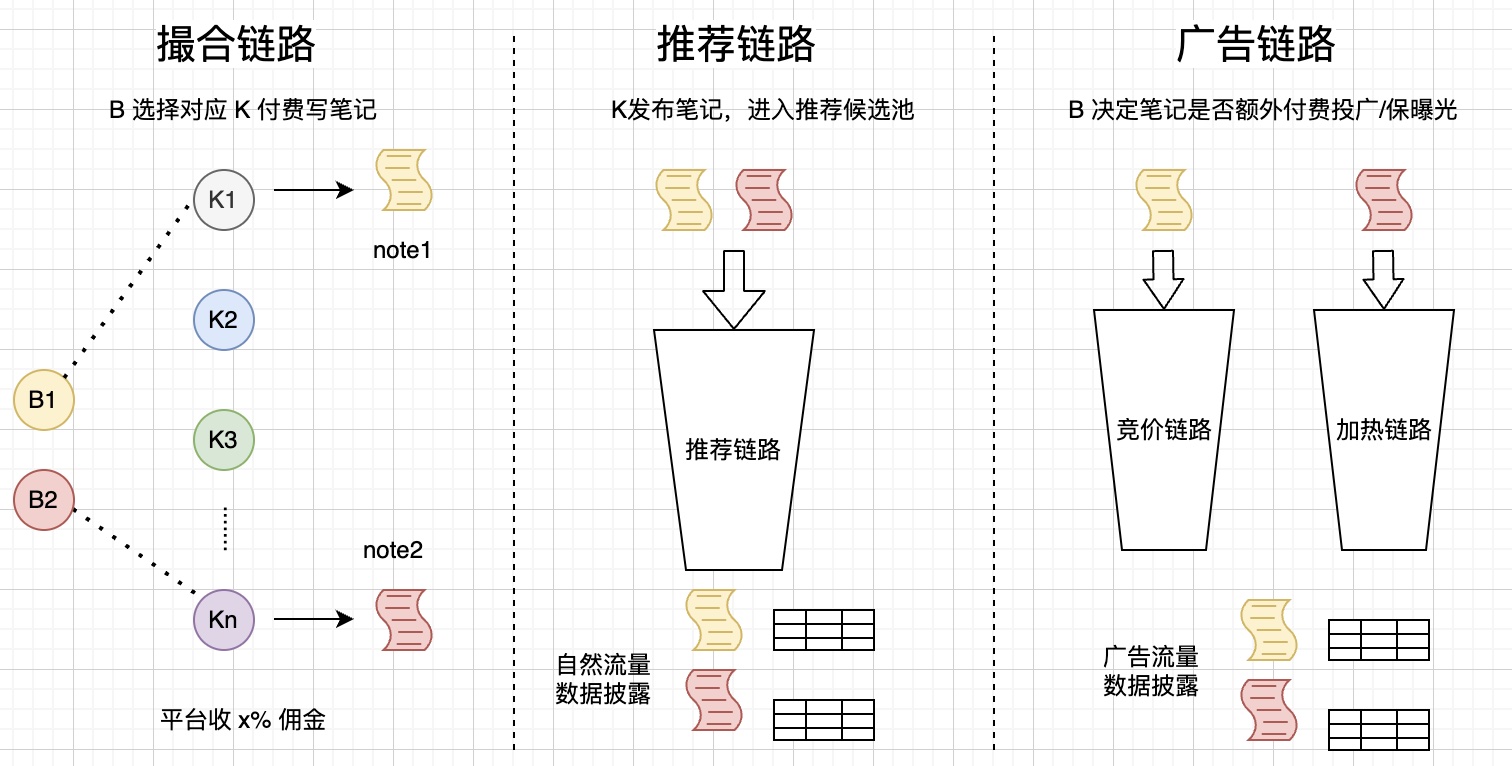
This section will expand on details of these three links.
Matching Link
The matching link’s basic responsibility is enabling B and K to reach collaboration (through 1v1 and 1vN modes), i.e., recommending creators for B on the platform. Analogous to common C-end recommendation systems, this is actually a B-end recommendation system, just with candidate set and system complexity far below C-end recommendation systems.
This system’s final optimization metric is B-K matching transaction volume. But besides volume, K’s opportunity distribution, B and K’s operation experience, etc. are also platform concerns. Because matching links often face the following problems:
Poor monetization product experience, like insufficient monetization modes, poor ease of use, unclear review rules, etc.
Insufficient creator monetization experience, lacking guidance, not knowing how to monetize
High industry concentration in transaction volume, overall concentrated in certain head industries, other industries have supply-demand imbalance
……
In link efficiency optimization, matching links often have significant challenges. Unlike common C-end traffic experiments where traffic is large and metrics are relatively easy to observe (like ad impressions, clicks, spend), this type of B-end experiment has limited traffic (only B-side users) and long transaction cycle (30+ days), making many product capabilities difficult to iterate for efficiency, or requiring very long observation periods.
From technical perspective, common approach is mining and improving intermediate metrics related to transaction volume. But in my experience, various intermediate metrics in the transaction process (like B’s CTR for K on page, B’s dwell time on webpage, etc.) aren’t that strongly correlated with final transaction behavior. So improving these intermediate metrics to drive transaction volume increase also has difficulty.
Therefore, on the matching link, algorithm side doesn’t have particularly good observable metrics when optimizing link efficiency, which is a pain point for technical optimization. So optimization direction is often improving matching capability diversity, i.e., providing richer paths and tools for B-side to find creators, like letting B-side express in diverse ways, e.g., finding creators through audience segments. Besides 1v1 precise targeting, also use 1vN recruitment methods, CPM/CPA/CPS settlement methods, together stimulating creator enthusiasm, especially waist-level creators.
Referencing Xingtu, matching product forms are often quite diverse:
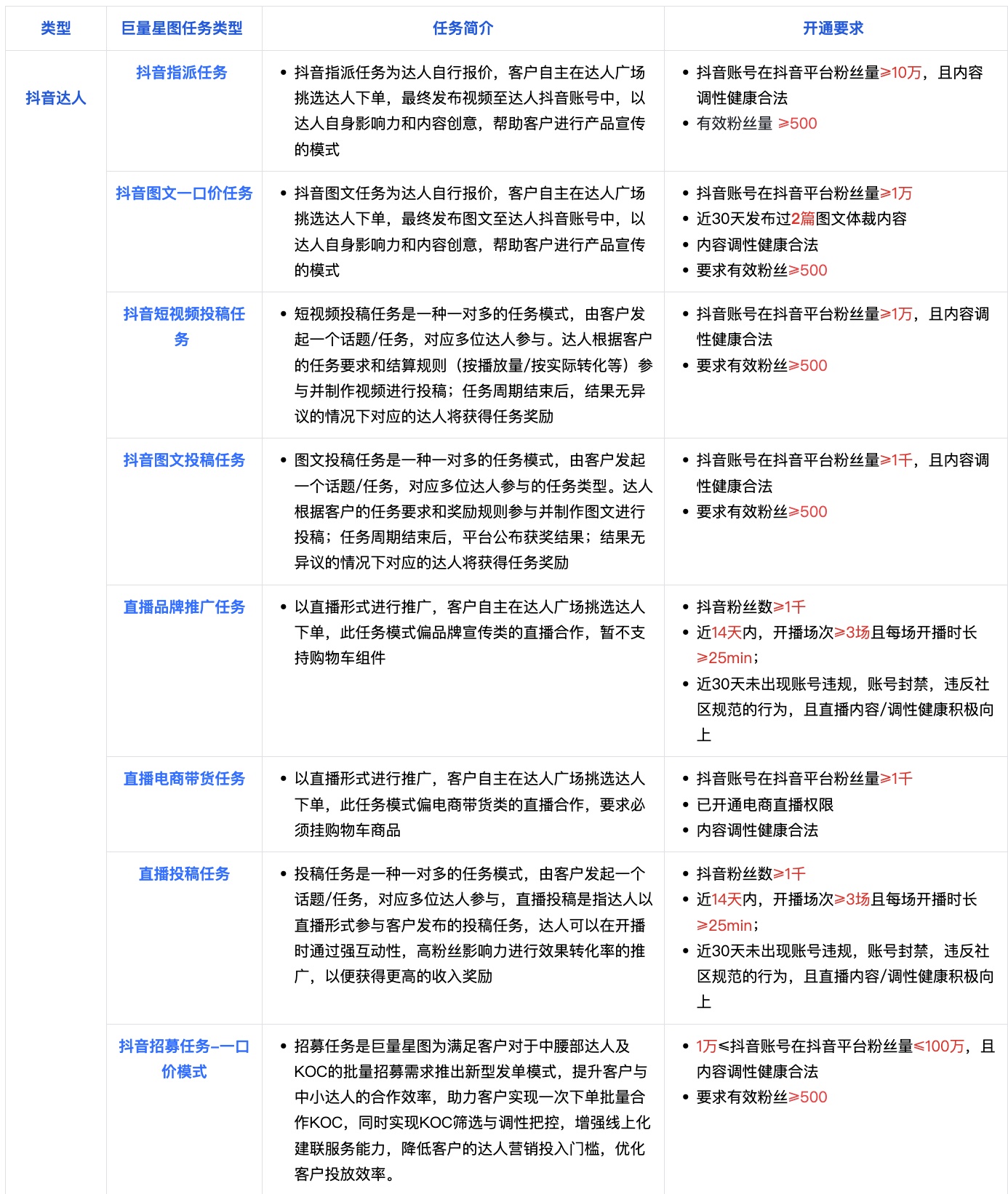
Another common optimization direction in matching is industry-based construction (similar to ads), mainly mining industries with strong demand (B) but insufficient supply (K), providing more industry-specific solutions.
Recommendation Link
After B and K reach collaboration, K publishes their created content. At this point the note enters the second link: recommendation link. This part is also the key optimization area on the technical side because it involves distribution-related traffic mechanisms, and is the key place affecting the other two links.
Let me first mention the most easily encountered problem in these matching products, the “underwater” problem. Let me explain a concept: above-water means B-K matching through official collaboration platform, requiring commission payment to platform. Underwater means B directly connects with K without going through platform.
From platform perspective, it definitely wants B-K matching to go above-water, because besides commission as profit, it can have better control over this type of opportunities. But from B’s perspective, going underwater saves commission and content is more native (some platforms explicitly mark above-water content), so underwater vs above-water gaming will be a long-term problem the platform needs to solve.
Therefore, to get more budget from underwater to above-water, the platform needs to do two things well:
Improve matching platform ease of use and efficiency, i.e., platform needs to make B and K connection easier
In traffic distribution, above-water needs differentiated distribution mechanism from underwater, and reveal benefits of going above-water to B-side
Point (1) is mainly related to matching link. Point (2) is strongly related to the recommendation link here, because B-K matched notes are basically no different in form from notes K publishes themselves, generally going through general distribution. In this approach, above-water and underwater notes have no difference in traffic distribution, so B has less incentive to go above-water.
So to convert underwater to above-water, above-water traffic distribution needs to be differentiated, considering more B-side benefits. Actually, K and B’s benefits/objectives aren’t binary opposites - fundamentally the platform intervenes in allocation of B’s money among different K. So first serve B willing to pay, then consider how to allocate well among different K.
B-side generally has marketing needs. Creatives bought on platforms like Xingtu and Pugongying are an important source of their ad creatives. The natural traffic effect after K publishes is a key factor affecting whether B uses this creative for advertising. As shown below, in B’s money-for-“creative+traffic” mode, the recommendation link’s natural traffic affects efficiency in both front and back links.
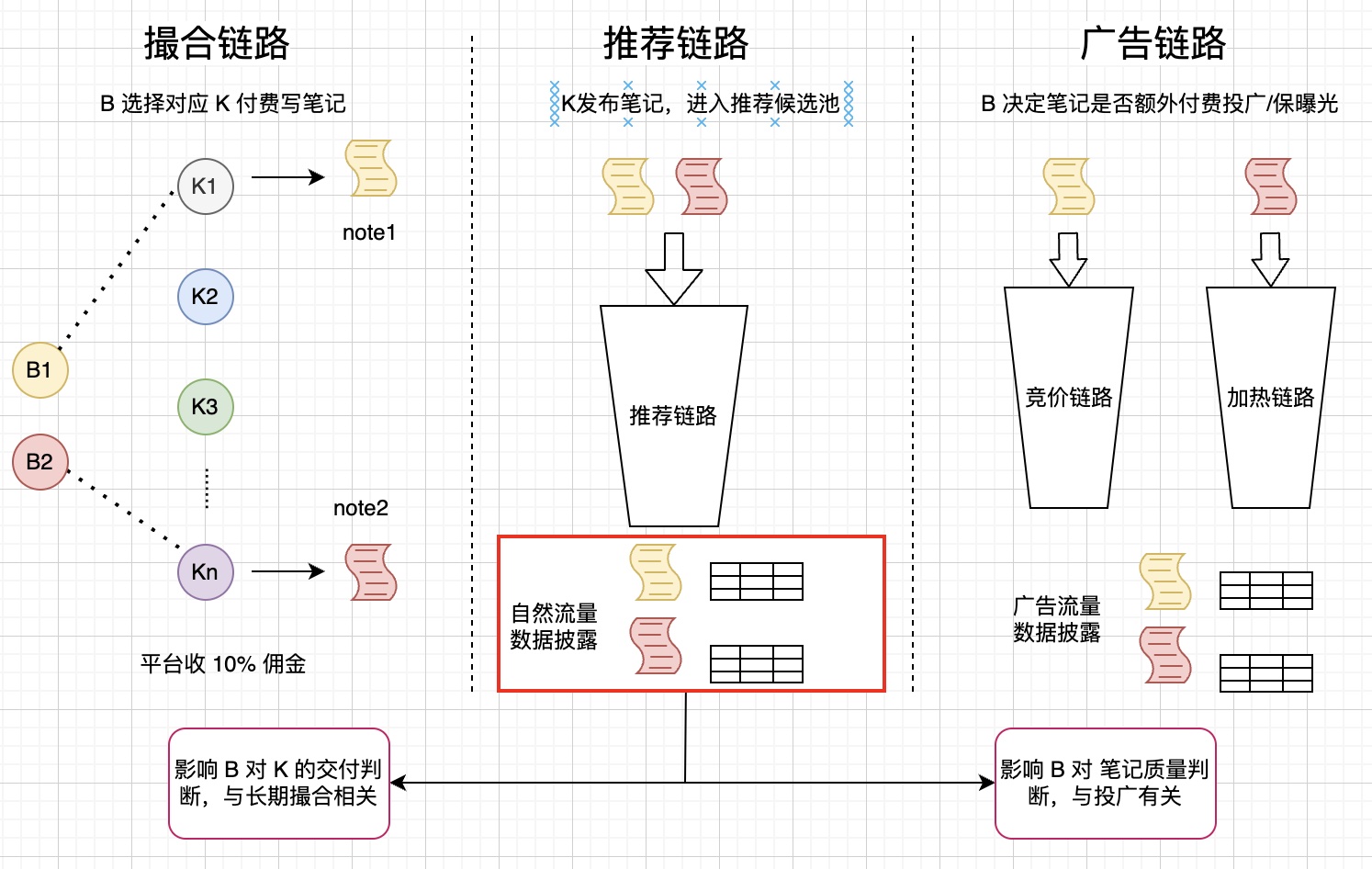
Therefore, differentiated traffic distribution refers to this natural traffic distribution method and effect. In practice, we can consider adding some B-side marketing objectives as part of the ranking formula for this traffic, while doing proper attribution and revealing to advertisers for this traffic.
Ad Link
As mentioned earlier, advertisers will use B-K matched creatives for advertising. In practice, we often observe this phenomenon - using B-K matched creatives for advertising yields better results. Reasons are often as shown below from Xingtu statistics (from 2024 Ocean Engine Marketing Playbook):
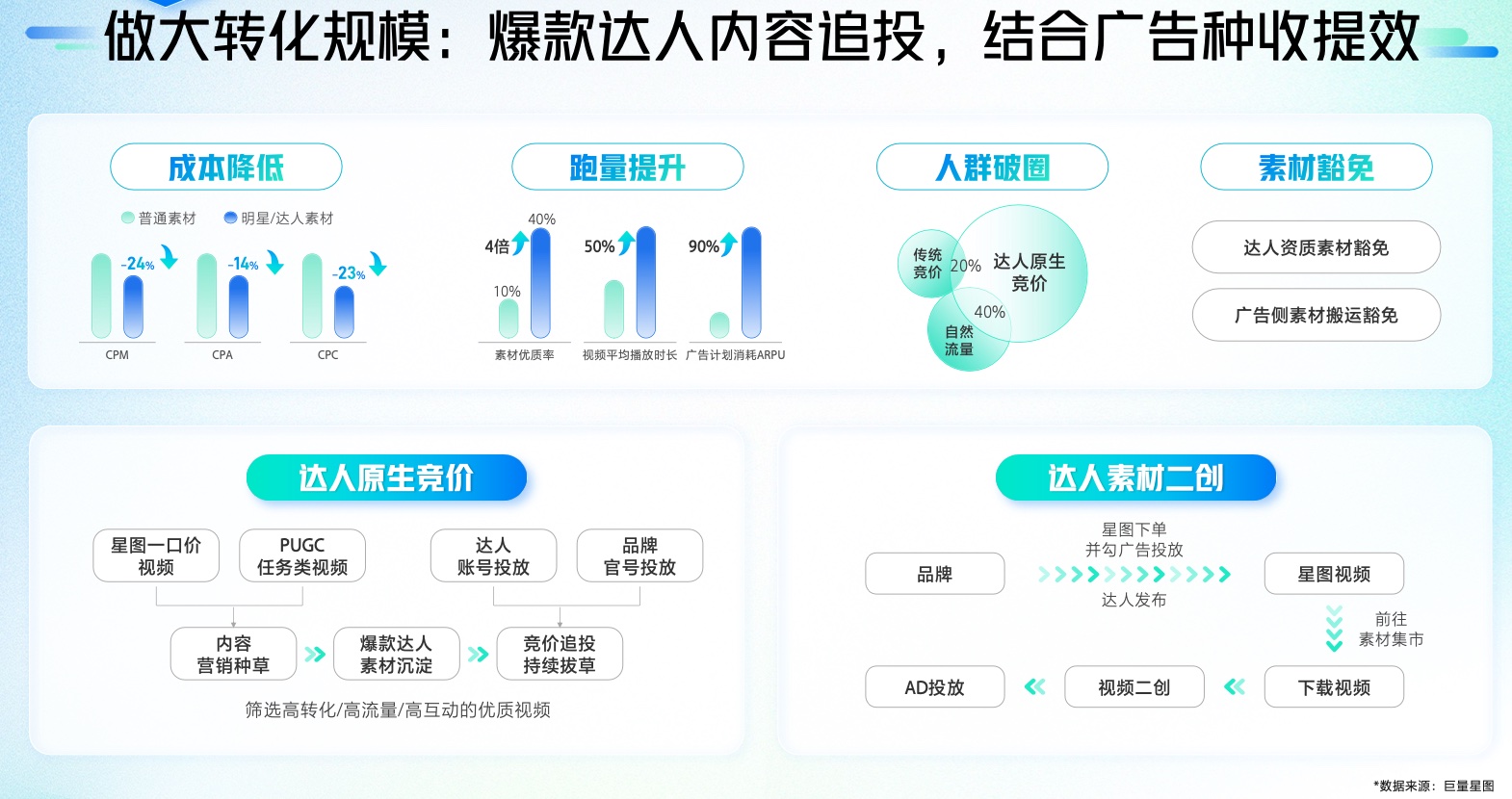
And an important basis for deciding whether to advertise content is these creatives’ performance on natural traffic. From technical perspective, these two traffic distributions are independent pipelines with different distribution objectives, so there’s a problem of weak traffic correlation, making traffic data less valuable for B-side advertising decisions. Simply put, if a client uses a note with good natural traffic data for advertising, actual ad performance might not be good. Clients lack methodology for choosing creatives to advertise.
From technical perspective, one direction for technical work is strengthening correlation between natural and ad traffic, i.e., making clients feel these two traffic sources are correlated. Because this natural traffic for advertising creatives is somewhat like cold start traffic for note advertising. Better utilizing this cold start traffic to assist client advertising can potentially drive growth in both matching transaction volume and ad transaction volume.
In specific technical approaches, as mentioned earlier, we can add some B-side marketing objectives in recommendation pipeline distribution as ranking formula terms. On this basis, sharing features/samples between these two traffic sources can strengthen ad cold start effects. For creatives performing well on natural traffic, when used for advertising, we can also try more aggressive ad bidding strategies.
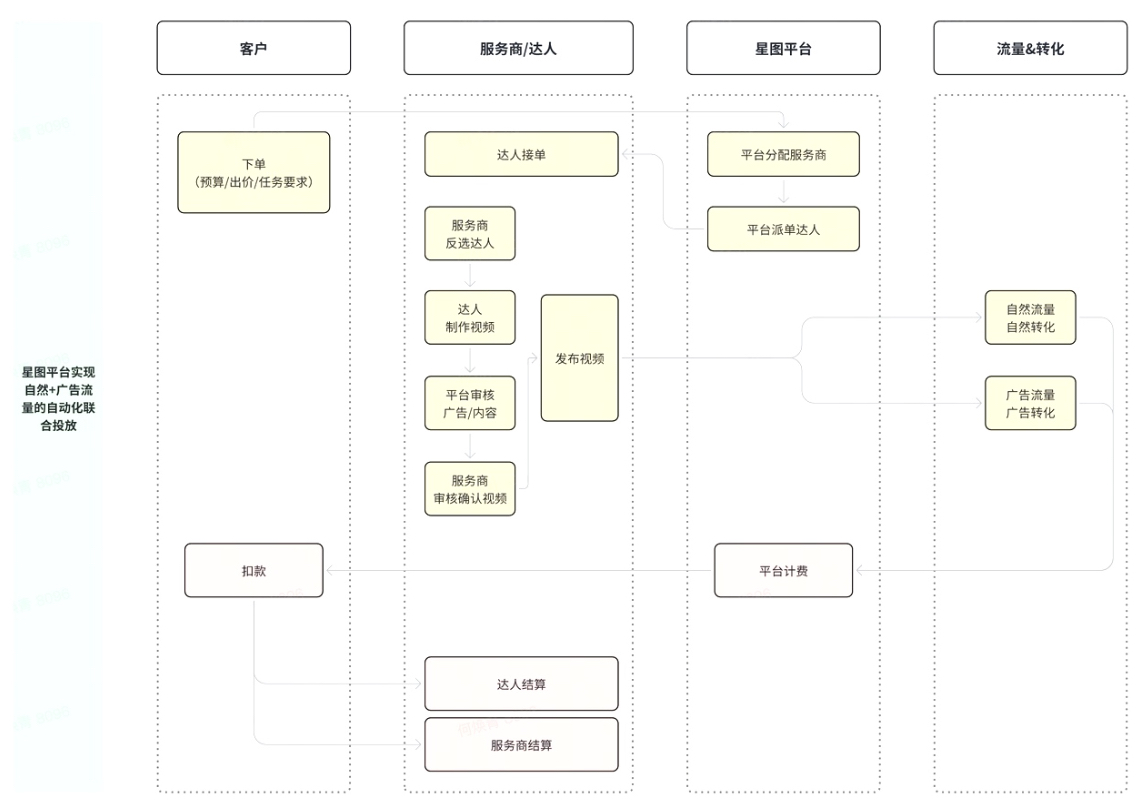
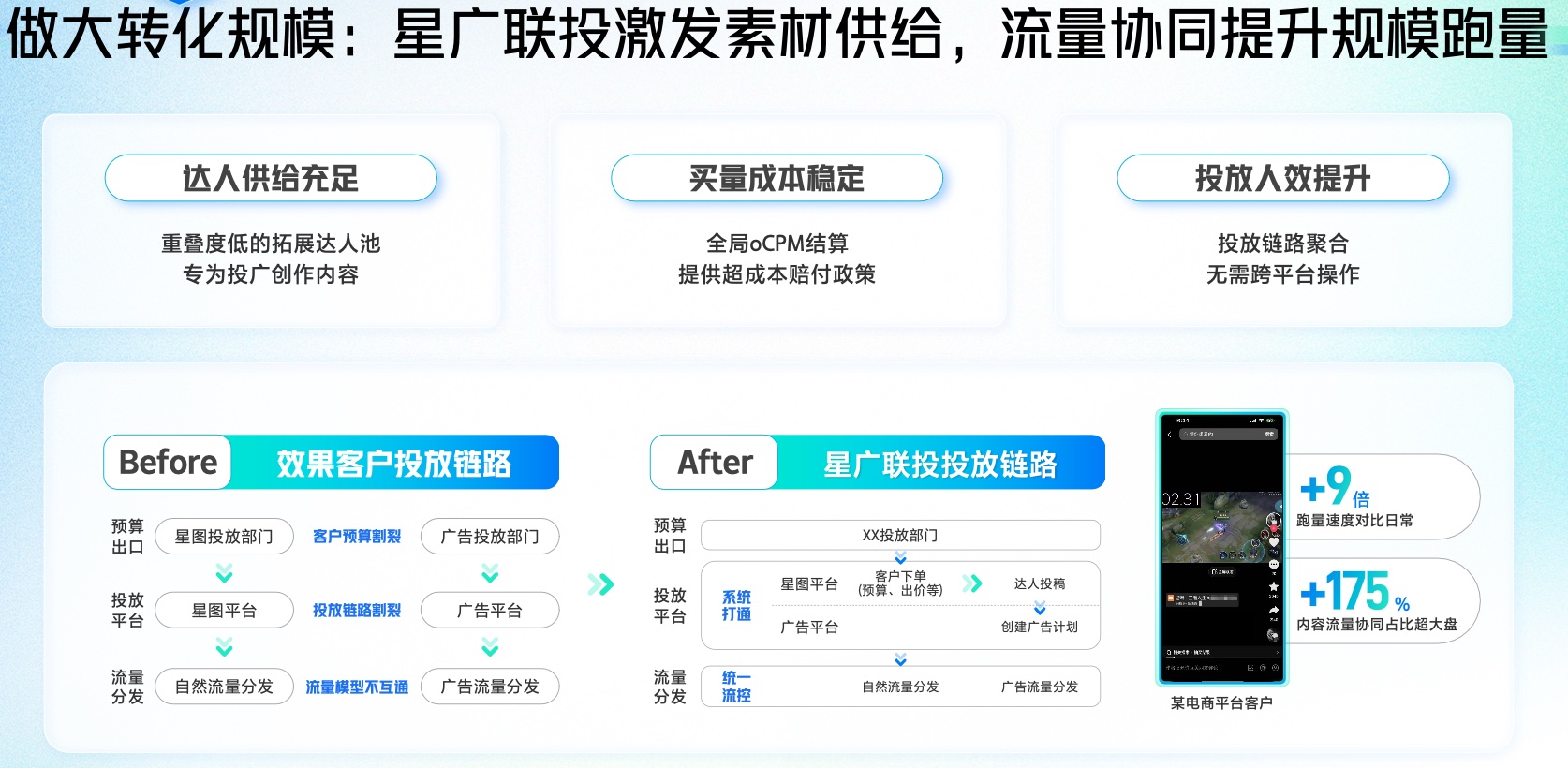
The most extreme linkage is products like Xing-Guang Joint Delivery. This product no longer follows the sequence of natural traffic first, then ad traffic, but uses client budget to do marketing on both natural and ad traffic simultaneously, as shown below:
Heating
Heating often complements opportunities. Heating is a paid tool creators use to assist their growth. After growing to a certain follower volume, they need opportunities to monetize. It’s somewhat like B-side perspective of planting and harvesting.
dou+, Fentiao, Shutiao and similar products are content heating tools serving all creators.
These products have requirements for creator content quality, often requiring not too strong marketing feel, with dedicated content review, and no marking. “Heating” also means weak optimization objectives, generally reading, likes/saves, profile visits, follows, etc., relatively shallow objectives.
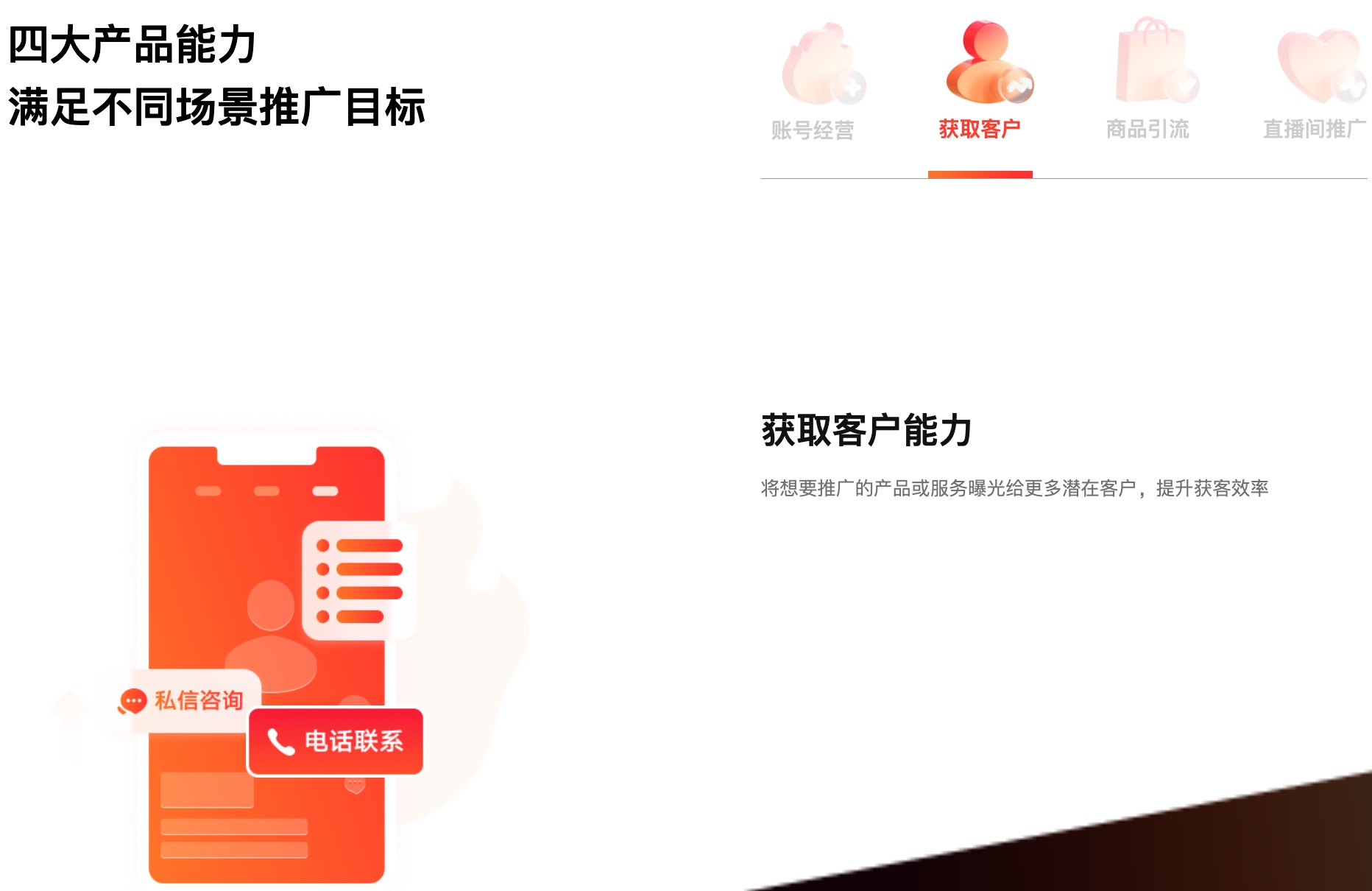
Meanwhile, dou+ also supports strong marketing objectives like customer acquisition, product purchases, livestream promotion, etc., as shown below. A major difference from the shallow marketing objectives mentioned earlier is who it serves. Heating generally serves creators, with main objective being their own growth. Strong marketing objectives serve advertisers with strong creative production capabilities. This advertising generally still evaluates cost, ROI, etc. This also relates to the traffic mechanism mentioned below.
Bidding and Budget
Because creators have limited understanding of ad bidding, they often choose nobid-type bidding to lower the barrier for understanding cost-based bidding like cost and compensation. There’s an interesting question here - viewing budget growth logic for various products from bidding perspective.
First, cost-based bidding like oCPX. Budget growth logic is through bidding, models, etc. optimization to make actual conversion cost closer to advertiser bid. Then as overall competitive ability strengthens and overall eCPM level rises, advertisers need to raise bids to get more volume. This is equivalent to advertisers willing to pay more for a conversion, platform selling conversions more expensively, driving overall revenue growth (with same conversion count).
nobid bidding can generally spend all budget. So nobid budget growth is often about lowering conversion cost, improving advertiser ROI, then advertisers willing to invest more budget.
nobid cost needs to continuously decrease, which seems contradictory to cost-based bidding mentioned earlier. From long-term overall spend growth perspective, adload, CTR, CVR all have upper bounds, meaning conversion count is limited. So continuously lowering conversion cost is equivalent to continuously lowering overall revenue.
Therefore, we can’t let nobid-type bidding product costs continuously decrease. The “advertiser ROI improves, then willing to invest more budget” mentioned earlier is a relatively long-term budget growth logic. In this process, costs often rise. For example, two nobid plans with identical configuration except budget - in this configuration, the higher-budget plan often has higher cost than lower-budget, because cheap traffic is limited in a period’s traffic pool.
So the problem becomes: when advertisers raise budget in nobid products, bringing simultaneous cost and volume increase, whether cost is still within advertiser’s expected ROI red line. If yes, they might accept cost increase. Therefore, nobid spend growth logic becomes: platform continuously optimizes advertiser cost through efficiency optimization, attracting advertisers to increase budget (within acceptable cost range), driving overall spend growth (since nobid budget can always be spent).
This way, nobid growth logic is similar to oCPX - selling conversions more expensively within advertiser’s acceptable range. The difference is raising bid in oCPX becomes raising budget in nobid.
Traffic Mechanism
Since heating products are essentially platform selling traffic (like advertiser products), in traffic distribution, a straightforward approach is competitive bidding between unmarked content and marked ads - i.e., ranking based on eCPM mixed competition with ads, same mixed ranking constraints, sharing ad load with ads.
But this reveals a phenomenon: once big promotions like 618 or Double 11 occur, under mixed competition, these heating products’ load decreases, while various marketing objective conversion costs rise.
The root cause is under mixed competition, this heating content competes for traffic with ads, so costs rise and fall with ad bidding overall cost level, unable to achieve relatively low costs. Creator budgets are small, bidding ability weak, so under mixed competition with large advertisers, they easily get squeezed by large advertisers. Or content quality + unmarked advantage in CTR/CVR can’t compensate for bid disadvantage.
Therefore, this type of unmarked paid heating content (some platforms call native ads) often needs independent ranking pipeline and load, while needing independent constraints in mixed ranking (first slot, minimum gap), or as one lane mixed with hard ads and recommendation content, avoiding being too severely squeezed by hard ads.
To some extent, this is a traffic value depression. Because creator heating products also bear ecosystem value of creator growth and enriching platform content, so this traffic is also a form of support for creator growth.
Self-Delivery and Proxy Delivery
Generally, creator heating products are self-delivery or proxy delivery, i.e., creators pay out of pocket to heat their own work, or creator fans voluntarily pay to heat creator notes. Overall budget is generally small, easily squeezed by large advertisers.
But there’s a slightly different proxy delivery mode, where platform selects UGC notes for large advertisers, then large advertisers heat these UGC notes. For example, taking Genshin Impact game - there are many UGC notes. Platform intermediates through “matching” to let advertisers willing to heat these UGC notes. Intuitively, this seems like a win-win-win model:
- For users, as long as they create good content, they have opportunity to be selected by platform and advertisers, receiving traffic subsidies (brand paid) and cash subsidies (optional)
- For advertisers, saving creative production costs. Platform selects notes with weaker marketing feel from massive UGC notes for brand delivery
- For platform, able to introduce more budget this way (possibly transfer), while using brand money to assist creator growth
But the product itself has limitations:
- Basically only suitable for large brands/advertisers, because brand needs to be well-known by users to have many UGC notes
- If large brands can spend budget well this way, they might not buy creatives on matching platforms anymore, potentially affecting matching transaction volume
In technical implementation, overall not much different from conventional heating. Main difference is involving note selection process, including pre-delivery selection and mid-delivery optimization. Because UGC note count is generally large, how to algorithmically select appropriate notes for brand to choose for delivery, or make managed optimization during delivery, is a problem to consider.
Summary
This article mainly discusses two things related to creators: opportunities and heating. The former is how creators make money, the latter is how creators spend money for growth.
Platform-launched matching products are important tools for completing opportunities. A complete lifecycle often involves three links: matching, recommendation, and ad links. Among them, traffic distribution in recommendation link is particularly important, because it simultaneously affects B’s judgment of K’s note quality and subsequent advertising decisions, thereby affecting matching transaction volume and advertiser advertising budget, etc.
Platform-launched heating products are important tools assisting creator growth. This article explores common nobid-type bidding budget growth logic for these heating products, traffic mechanism, and a new proxy delivery product form. In this process, the platform needs to fully exercise initiative, especially for traffic mechanism, not considering this traffic’s value only from revenue perspective.